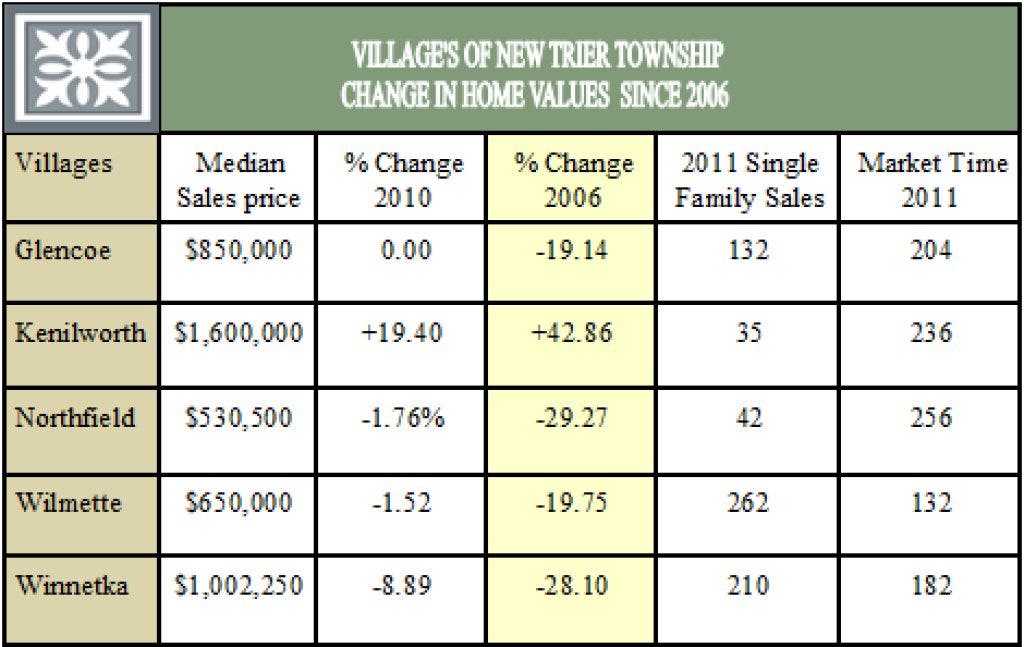
It has been nearly seven years since the height of the housing bubble and the question I hear most often is, "How have property values on the North Shore held up in comparison to Chicago as a whole?". The Chicago Metro area is down 35% from the market high of 2006 through end of 2011. Referencing housing data from a recent article in the April edition of Chicago Magazine, entitled: Boost Your Home Value , I put together the chart above, tracking the percentage change in single family home values from 2006 through the end of 2011, for the Villages comprising New Trier Township. I was encouraged to see that none of the Villages experienced a decline in home values to the degree of Chicago as a whole. In addition, home values in Kenilworth were actually up for this period of time, a whopping 43% (however as with any study, the smaller the data to draw from, the greater the chances the numbers can be skewed). So yes, much of the North Shore has experienced declines in property values, as did 87 % of Chicago suburbs, but at the end of the day, the North Shore fared better than most. The good news on the horizon is inventory is down for much of the area.....and if this trend continues, it is a sign that home values are headed upwards! Interested in learning more about local home values, go to: NewTrierLiving.info .
As for my views on property taxes here on the North Shore, specifically pertaining to the villages comprising New Trier Township, it is the smallest township in Illinois. The less parcels available to generate revenue(properties) the greater the percentage of taxes assigned to each. In addition, the villages comprising New Trier Township are considered “Bedroom Communities”. By definition, these communities have little commercial or industrial activity beyond a small amount of retail, oriented toward serving the residents; meaning limited tax revenue are generated from local businesses With regard to the calculation itself, the two most critical factors in determining the assessed value of a property are recent sales price and the square footage of the home. Location and size of lot are also of consideration. Lastly, property values are reassessed every three years and you can contest your taxes every year, if so inclined, however there are no guarantees you will be successful.
And why wasn't Glenview mentioned? We live in New Trier township... Afraid it might skew the numbers, since we took the biggest hit of all? We chose to live in the Northshore (well, i'm not sure Glenview is actually considered the Northshore) for all the reasons mentioned, but i agree with the lady from out east: the real estate prices and especially our property taxes are out of control... I can deal with the housing prices around here because it's all relative: you get much more for your money than say, the Bay Area or NYC.... And this area is considered by many to be among the most desirable areas in the Chicago market, so you're gonna pay a premium to buy a house around here... But how much of a burden do we, the taxpayers, have to endure????
Remember, if you work full time in the USA, you are extremely likely to be one of the world's 10%ers and the other 90% hate you like you hate 1%ers. What goes around, comes around.
New Home Sales Miss By Most In 20 Months But, but, but... the housing recovery. Was demand pulled forward? Could it be that warm weather encouraged people to venture out of their igloos? It appears so as new home sales plunge 8.4% MoM on expectations of a rise of 0.7%, days after the already fudged NAR data showed a huge miss in existing home sales as well. This is the first miss since October of last year and the biggest miss of expectations since October 2010. This is the biggest absolute drop since January with the actual number of new homes sold, not annualized, in June was 33,000 - of which a mere 1,000 was in the NorthEast. Median home prices also fell appreciably. Hope.is.fading as we note that of the 33,000 total new houses sold in June, 11,000 have not even been started, and 11,000 are still under construction and the number of homes sold at a price over $750,000 was less than 1,000.