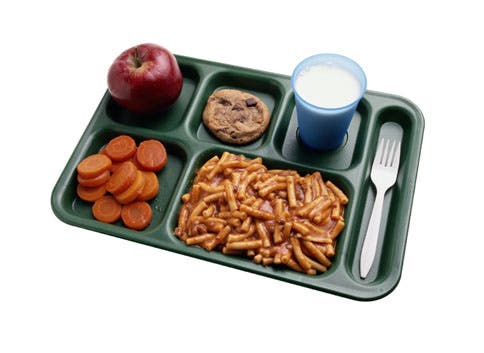
The Centers for Disease Control and Prevention estimates that 4-6 percent of children in the U.S. under 18 have food allergies, and that number is rising.
School can be a particularly dangerous place for these kids. The CDC says that 16-18 percent of them have had an allergic reaction at school due to accidentally ingesting a food allergen.
Odds are that if your child isn’t one of those with a serious allergy, he or she goes to school with someone who is. Because schools are required by federal law to make adjustments for any student with a life-threatening allergy, this may mean nut-free tables in the lunchroom, or even an entirely nut-free school.
If you’re in either of those categories, how do you pack a healthy, allergen-free lunch for your student? Patch has rounded up some ideas, and we’d like to hear your thoughts in the comments section below.
The Adventures of a Gluten-Free Mom blog has some great sounding recipes that she uses with her kids, including vegan pumpkin dip and homemade beef jerky, that would qualify as dairy- and nut-free, too.
She advises to, “allow your children to have a say in what goes into their lunchbox (from a mom-approved list of healthy options of course). Not only will your kids be more likely to eat it, but if you do it right, you can get them eating all sorts of healthy goodness.”
There are lots of sites that focus on peanut-free healthy lunches, such as Livestrong, which suggests making sandwiches with sunflower seed butter, or packing yogurt parfaits with fruit and granola or humus wraps.
Are these scenarios ok with you? A) My 6 year old enjoys eating puffer fish. I send a puffer fish with him to school each day. He knows which parts not to eat because they're poisonous, and he leaves those on his plate and discards them when he's done eating. Oh, and he sits next to your son during lunch. B) 50% of the kids in your child's class are deathly allergic to peanuts. The other 50% bring peanut butter into the classroom every day for snack. I think (at least I hope this is the case), that people that have your opinion is based mostly on inconveniencing the many for the sake of a few. In general in life, I believe that is a fine attitude to have. If one person gets offended by a word, the other 999 people that use it shouldn't be forced to change. But we're talking about the opportunity for killing a child, who can't be expected to fully defend himself in a world that doesn't fully understand his plight. We're already restricted in all kinds of ways. What substances I can smoke, where and when I can drink alcohol. Most of the reasons are so that I don't harm others by my consumption of those substances. In a world with a growing problem with life threatening peanut allergies, why can't peanuts be treated in a manner similar to drugs?
A) I'd hope that when my son is old enough to attend school that I've taught him well enough so that he doesn't pull a George Costanza and eat out of the garbage can. That said, when I was 6, I was raising salt- and freshwater fish, so I knew what was dangerous and what wasn't. Honestly, one of things I plan to teach my son about is Ichthyology. B) The 50% who are deathly allergic to peanuts ought to be in a facility that can accommodate their special needs. It could be that someone ate a cookie which doesn't contain peanut butter, but which happened to be made on a line that also processes peanuts and tree nuts, encounters a crumb or cookie dust particle and has a reaction. No one should have to modify what they choose to eat simply because someone else is allergic to it. The person with the allergy should manage their own allergies and needs. You're right though - children can't fully defend themselves. I refuse to even consider that peanuts or other foodstuff are to be treated as or restricted as are drugs - where does it end? What if someone is allergic to twinkies? Coffee? Tea? It's truly absurd.
To me this is the same as smoking. Maybe you don't agree with that law either since it inconveniences smokers to save the rest of us.
That's precisely why if someone has a life-threatening allergy, they ought to have a facility dedicated to dealing with their type of needs. Let's assume our 6 yr old food spitter ate a cookie which doesn't have peanuts in it, but was made on a processing line that processed peanuts. This cookie ended up getting a bit of peanut in it. Now our 6 yr old food spitter is eating, and a crumb, a mere particle of cookie is expelled from his mouth, across the table, and lands on the lips of Jimmy, who's highly allergic to peanuts. Jimmy has a reaction. Do you then blame the 6 yr old food spitter? The school? The parents of the 6 yr old? The mfr of the cookie that had no peanuts but ended up having a particle of peanut in it somehow? I wouldn't blame any of those people - because it's none of their business if someone else is allergic to something that they may choose to eat. It's the business of the person who's allergic - and if they're that highly allergic, they need to be someplace where nothing can be eaten that will harm them. Nothing that was processed on a line that might have had peanuts, nothing with peanuts. No one who works at the facility who eats nuts, etc. And it's not the same thing as smoking (no I'm not a smoker).
OR, some employee of the school chooses to enjoy a few nuts the evening before while driving home from a baseball game. He gets some dust on his steering wheel. The next morning he drives to school for the work day, picks up the dust on his hands, and then touches the doorknob that Jimmy then touches. Jimmy has a reaction. What you're saying is that no one should ever eat peanuts, anything with peanuts in it, or which has been processed on a line that handled peanuts because that residue can then cause a reaction in someone else. And I'm saying that's absurd to restrict what someone eats, especially so off-campus, just because someone has an allergy. It's the responsibility of the person with the allergy to deal with their allergy. If the facility can't 100% guarantee their freedom from allergens, then that allergic person needs to go to a facility that can.
With that said, I don't know if a completely separate school is necessary. However, having a special wing in the school designated as a lunchroom for kids with food allergies seems like a way to eliminate 80+% of the risks.
Someone sensitive encounters the residue, and we have a problem - which varies in severity depending upon the allergic individual. It's virtually impossible to control. And even if you ban all use of peanuts - when the next allergen rears its ugly head, then what?
The question I posed wasn't about PB in particular (although that's a common one, so that's where this discussion has gone), but rather what the point is that the whole "you can't have this because so-and-so is allergic to it" becomes absurd. What if you have someone who's allergic to a particular soap fragrance? Let's call it "Irish Spring" - do you then say "Sorry, no one can wash with Irish Spring"? So then everyone uses "Ivory" - and when someone's allergic to "Ivory" - then what? My question is at what point is it reasonable to demand that the allergy sufferer deal with their own issue because it's too onerous on the rest of the population? And my other question is what about when these allergy sufferers become adults? Do we restrict an entire office building or high rise from peanuts because one person has a peanut allergy?
We could discuss that as well, but I fear that people would become similarly upset. My sympathies to you for the celiac disease and the impact it's had on your and your family's life.
This is an EXAMPLE, a WHAT IT, a THOUGHT EXPERIMENT for discussion. Who would win in that case?
And once again, I chose to bring that information to the awareness of the Public-at-Large so they could better understand the risks of the technology. http://blog.motorists.org/red-light-cameras-increase-accidents-5-studies-that-prove-it/ http://arstechnica.com/tech-policy/news/2008/12/dont-like-speed-cameras-use-them-to-punk-your-enemies.ars http://yro.slashdot.org/story/08/12/21/1751210/Using-Speed-Cameras-To-Send-Tickets-To-Your-Enemies http://www.thenewspaper.com/news/26/2632.asp http://www.txt2pic.com/signs/license/usa.asp?state=il&title=illinois&page=1 And the article where I made these comments: http://highlandpark.patch.com/articles/red-light-camera-exposes-dangerous-driving-at-intersection
Funding comes from a variety of sources.
Reasonable rules are made to deal with these issues. Teachers and staff also have to be careful. Most people don't mind the inconvenience if it might save a life.
It's certainly something for thought and consideration.
Sully, I'd never discriminate against anyone. SOME food allergies DO cause learning problems. And I'm not proposing that kids be separated from their peers because of what they can't eat, but rather because they have special environmental needs that can't be guaranteed and met by the regular environment. As we've discussed above, kids are slobs - things can happen outside the regular campus environment that can adversely affect a sensitive individual, and to meet the needs of the sensitive individuals in the regular environment approaches the absurd. So we need a special environment so they can learn and be safe. That's ALL I'm saying.